
Building teams that stay: a fresh approach to recruiting senior anaesthetists and intensivists
Every theatre list and intensive care bed depends on a small number of senior doctors with very particular skills. Anaesthetists and intensivists sit at the heart of planned surgery, emergency care, maternity and critical care, so when these teams are well staffed, so much else becomes possible. Medical staffing teams across the NHS work incredibly hard to make that happen, often in a highly competitive market.
As demand grows, there is a real opportunity to look again at how we find, attract and keep these doctors, and to make sure recruitment strategy evolves alongside everything else the NHS is doing to meet that demand.
A national picture, shared by every hospital
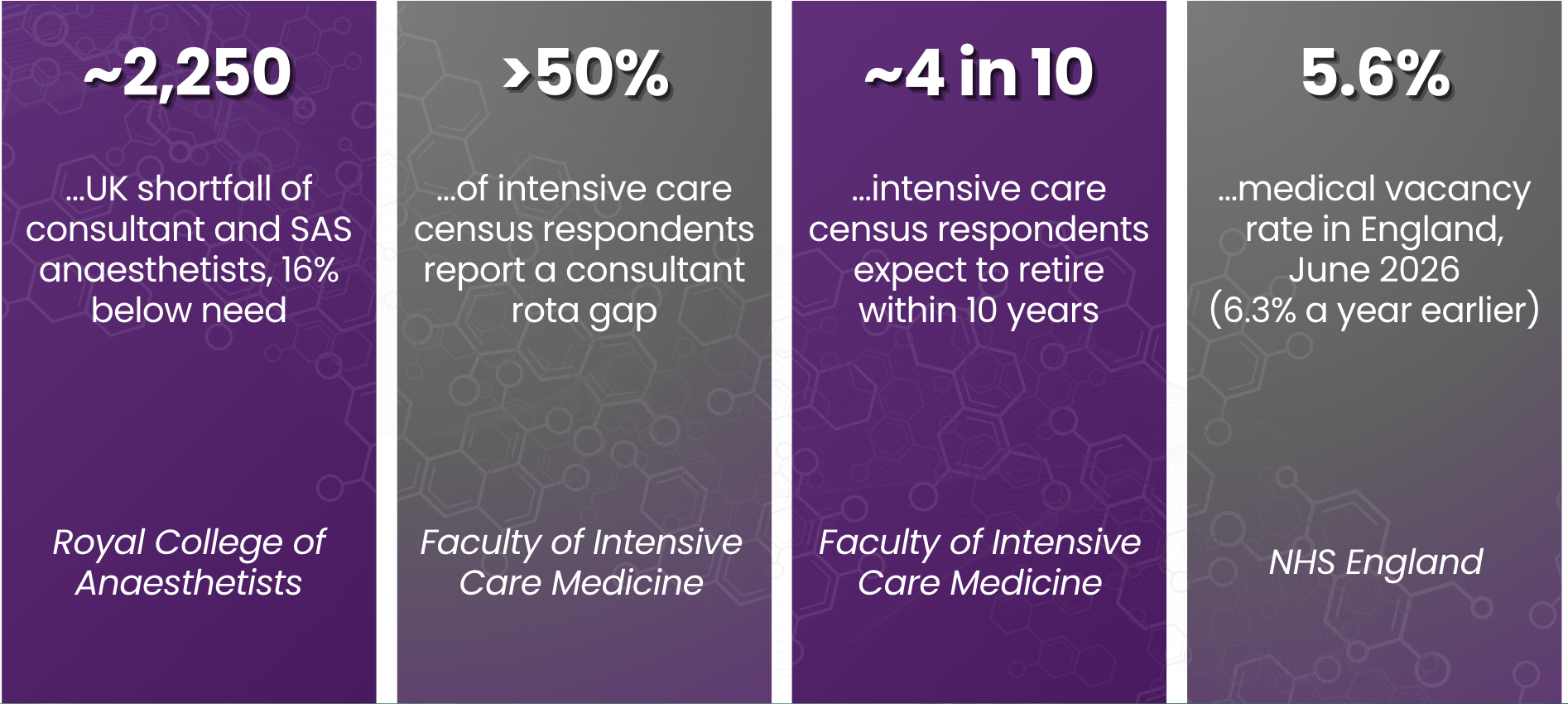
The challenge is shared across the UK and spans every senior grade, from consultants and specialists to specialty doctors and clinical fellows in anaesthesia and intensive care. The Royal College of Anaesthetists’ latest workforce census found that consultant and SAS anaesthetist numbers have grown to around 12,050, but demand has grown faster, leaving a shortfall of around 2,250 anaesthetists, or 16% below what is needed. In intensive care, the Faculty of Intensive Care Medicine’s 2024 census found that more than half of respondents reported at least one gap on their consultant rota, and around four in ten expect to retire within the next ten years.
There is encouraging news too. NHS England’s latest vacancy statistics show the medical vacancy rate in England easing to 5.6% in June 2026, from 6.3% a year earlier. Because experienced anaesthetists and intensivists have real choice, it is common to see the same senior posts advertised more than once before the right person is found. That simply reflects how specialist and sought-after these doctors are, and it shows the value of reaching them in more ways, and at more moments, than a single advert can.
Stable teams, local services
Workforce stability is about far more than filling a rota. Settled senior teams underpin the range of services a hospital can offer its community: planned surgery, maternity anaesthesia, emergency care and critical care close to home. That matters everywhere, and especially for smaller and rural hospitals, where a handful of appointments can make a real difference.
The positive flipside is that good recruitment compounds. Each successful appointment strengthens rotas, supervision and teaching, and makes a department more attractive to the next applicant. Small, well-targeted gains can build into lasting resilience.
Evolving the approach, together
Across the NHS, recruitment for scarce specialties is already evolving. In our experience of working alongside medical workforce teams, a few approaches make a real difference:
- Keep pipelines warm all year. Ongoing relationships with doctors in the UK and overseas mean a new vacancy can meet a shortlist rather than starting from scratch.
- Recruit internationally, and ethically. Many outstanding anaesthetists and intensivists trained overseas want to build UK careers. Doing this responsibly means following the Code of Practice for international recruitment, respecting the WHO health workforce support and safeguards (‘red’) list, and properly supporting registration, relocation and induction.
- Tell the story of the place as well as the post. Every hospital has a great deal to offer: broad clinical exposure, close-knit teams, the chance to shape a service and a good quality of life. Sharing those stories directly helps the right people find the right roles.
- Design flexible job plans. Blended anaesthesia and intensive care sessions, protected development time, support towards specialist registration and less-than-full-time options open up a wider pool.
- Use permanent and fixed-term roles together. Fixed-term posts can be a bridge to permanence, giving doctors and departments the chance to get to know each other and helping to build settled teams.
- Partner early. Specialist recruiters can work as an extension of in-house teams, searching proactively and engaging doctors who are not yet actively looking.
"Good recruitment compounds. Each successful appointment makes a department more attractive to the next applicant."
~ Stella Redgrave-Nevison
A shared ambition
At Indigo Healthcare Recruitment, we place doctors in permanent and fixed-term roles. We don’t supply locums; our aim is to help NHS organisations build settled teams and reduce their reliance on temporary cover. We’re proud to support the NHS through the HealthTrust Europe framework, and prouder still of the doctors who have built their careers there.
The challenges are real, but so is the opportunity. As the NHS evolves to meet growing demand, recruitment strategy can evolve with it, and when it does, the results last.
Let’s Talk
If you lead medical workforce, anaesthesia or critical care, I’d welcome a conversation about what’s working for you and where we might help.
Get in touch at contactus@indigohealthcare.co.uk.
