
Level Three Recruitment: Why “Right First Time” Is No Longer Optional.
Most hiring decisions feel right at the point they’re made. The CV stacks up. The interview is smooth.
References confirm what you already want to believe. On paper, everything looks sound. And yet months later, sometimes much later, it becomes clear the hire isn’t delivering what the business truly needs.
By that stage, the cost is no longer theoretical. A failed hire typically costs between two and three-and-a-half times salary, depending on how long it takes to recognise the issue. That figure includes lost productivity, disruption to teams, re-hiring costs and the opportunity cost of momentum lost while the role underperforms.
This is exactly where Level Three – Right First Time recruitment comes in.
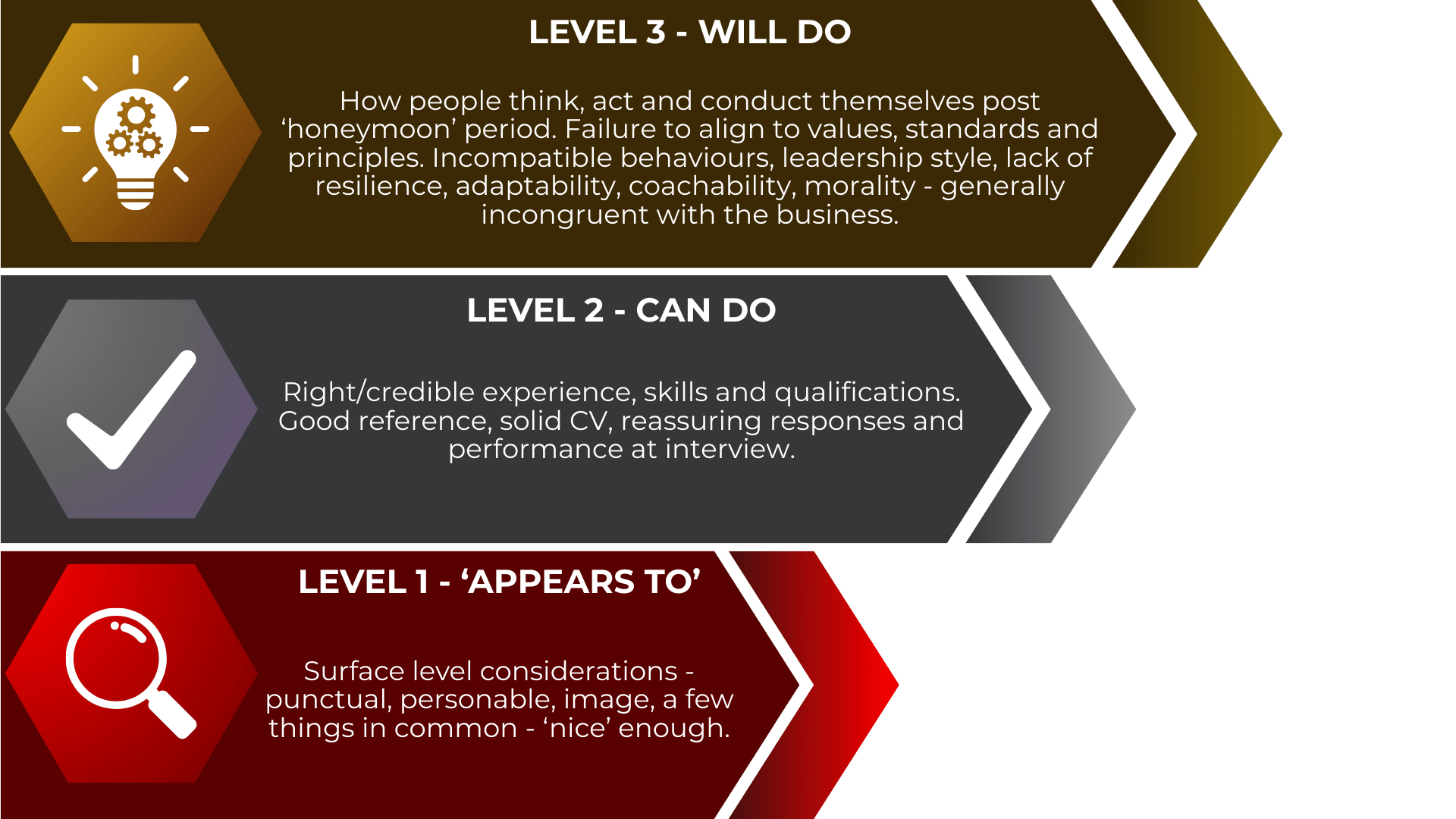
Traditional recruitment focuses heavily on what we call Levels One and Two. Level One is surface-level fit. The person appears right. They are personable, confident and present well. Level Two goes deeper, assessing whether they can do the job through experience, qualifications and interview performance. Most hiring stops here.
The problem is that neither level tells you how someone will behave once the honeymoon period ends.
Level Three looks at what actually determines long-term success. It focuses on how people think, act and conduct themselves when pressure increases, priorities clash and the role evolves. This is where values alignment, decision-making style, resilience, adaptability and leadership behaviours come into play. When these don’t align with the organisation, performance erosion is almost inevitable, even if capability is strong.
Our Recruitment 2.0 strategy was built around this reality and the results speak for themselves. Across complex and senior appointments, it is delivering 98.8% vacancy fulfilment, a 98.1% time-to-fill score, 96.4% long-term retention, full compliance and PLS alignment, and a 4.8 positive candidate experience rating. These outcomes aren’t driven by speed alone, but by deeper assessment, clearer definition of success and disciplined decision-making.
In practice, Level Three recruitment blends market intelligence with behavioural insight. We map sectors and sub-sectors in detail, approach talent directly rather than relying on applicants, and shortlist against real-world scenarios rather than hypothetical interview answers. Personality and psychometric assessment are used to understand how a candidate will actually operate within the leadership team and culture they are joining, not how well they perform on the day.
This approach has recently supported the successful delivery of roles such as International Sales Manager, EMEA Technical Sales Manager, Strategic Buyer, QHSE Lead, Senior HR Business Partner and transformation-focused Process Improvement and QSM leadership positions. In each case, technical capability was only part of the equation. Long-term success depended on alignment at a behavioural and cultural level.
Supporting this is a dedicated international team specialising in global resourcing, talent acquisition, high-volume projects and market insight. This enables clients to make informed hiring decisions based not only on individual candidates, but on how talent markets actually function across regions and sectors.
Ultimately, Level Three recruitment reframes the hiring question.
It moves organisations beyond “Can this person do the job?” to “Will this person succeed here, sustainably, as the business changes?”
That distinction is what protects performance, culture and commercial outcomes over the long term.
For organisations that want to explore this in more depth, we provide access to real client case studies, live project examples and anonymised datasets that show how Level Three assessment directly impacts retention, performance and hiring ROI.
Because getting recruitment right first time is no longer a nice-to-have. It’s a measurable business advantage.
